
Forgotten Impact
Wesley, PECUSA, and the Books of Homilies

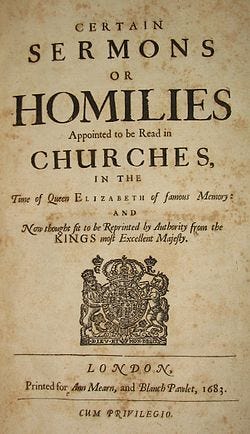
Elsewhere, I have remarked that the two Books of Homilies are “Forgotten Fenceposts.” This often elicits a response of “good riddance” from some Anglicans of varying churchmanship and theological parties. However, the Homilies were deeply influential well beyond their initial drafting during the Edwardian and Elizabethan eras, resulting in the reform of the Church of England. They were cited by Caroline divines, the Oxford Movement, the Evangelicals of the 1800’s, and also by a certain priest who is oft-forgotten by Anglicans as being one of their own, John Wesley.
Wesley condensed and weaved together the homilies Of the Salvation of Mankind, Of the True and Lively Faith, and Of Good Works. These three homilies originate from the first book of homilies and were edited into an easily digestible, twelve-page tour de force by Wesley on our salvation. Notably, it was the other famous Methodist-Anglican, George Whitfield, who published the work, which is still available online. This short resource is prime material for rectors seeking a Lenten resource to distribute to their parish or use as a teaching resource either mid-week or during Sunday School. If there’s any interest in a modern typesetting of Wesley’s work, you can download it below:

The disparaging of the Homilies is a shame. No one claims they are infallible, but as the GSFA Covenant upholds them, we should take notice:
To all who have decided to remain faithful to the historic biblical faith expressed in the Anglican formularies (the 39 articles, the Book of Common Prayer, the Ordinal and the Book of Homilies) …
- The 9th Trumpet, Communique from the First Assembly of the Global South Fellowship of Anglican Churches, June 11-15, 2024, at paragraph 14, (available at: https://www.thegsfa.org/news/ninth-trumpet-communique-from-the-first-assembly-of-the-global-south-fellowship-of-anglican-churches) (emphasis added).
Further, GAFCON members and members of Anglican provinces like the ACNA, who uphold the authority of the Articles of Religion via the Jerusalem Declaration and Fundamental Declarations (ACNA Constitution, Article I), should recall that there is an entire Article on the Homilies.
This was not forgotten by John Wesley, who remarked in a sermon:
The book which, next to the Holy Scripture, was of the greatest use to them, in settling their judgment as to the grand point of justification by faith, was the book of Homilies. They were never clearly convinced that we are justified by faith alone, till they carefully consulted these, and compared them with the sacred writings, particularly St. Paul’s Epistle to the Romans. And no Minister of the Church can, with any decency, oppose these; seeing at his ordination he subscribed to them, in subscribing the thirty-sixth Article of the Church.
- John Wesley, On God’s Vineyard, Sermon 107 (emphasis added).
The early Methodists, faithful Anglicans seeking to live the prayerbook life wholly and completely, were regular readers of the two Books of Homilies and inspired in part by them and their reliance upon the Church Fathers to regularly receive holy communion and celebrate the feasts and fasts of the prayerbook. The Homilies have much to say about the sacrament of the Lord’s Supper, faithful reception, feast days, and fasting, all of which the early Methodist-Anglicans took to heart and implemented, much to the chagrin of many Latitudinarian bishops.
Even across the pond, here in the States, the Homilies were not abandoned wholesale, but instead were received in the American Articles of Religion as follows:
This Article [Of the Homilies] is received in this Church, so far as it declares the Books of Homilies to be an explication of Christian doctrine, and instructive in piety and morals. But all references to the constitution and laws of England are considered as inapplicable to the circumstances of this Church; which also suspends the order for the reading of said Homilies in churches, until a revision of them may be conveniently made, for the clearing of them, as well from obsolete words and phrases, as from the local references.
- Article XXXV, PECUSA Articles of Religion (1801) (attached to the 2019 ACNA Book of Common Prayer at page 789 as a Documentary Foundation).
Notably, the American Anglican experience has no disagreement as to the “explication of Christian doctrine, and instructive in piety and morals.” The reading of the Homilies was simply suspended as to public sermons “in churches,” and then, only insofar “until a revision of them may be conveniently made.” Such a revision was not to remedy doctrinal errors, but to update and edit them for “obsolete words and phrases, as from the local references” to “the constitution and laws of England.” Id. Unfortunately, this updating has yet to occur as of today’s date, though perhaps the ACNA will take up the mantle (though I would not hold one’s breath).
Yet there was a PECUSA bishop, William Meade, the third bishop of the Diocese of Virginia and later the first presiding bishop of the short-lived Protestant Episcopal Church of the Confederate States, who wrote a Preface to an edited, condensed, and abbreviated version of the two Books of Homilies published by the “Executive Committee of the Protestant Episcopal Society for the Promotion of Evangelical Knowledge.” This work was entitled, Selections from the Homilies of the Protestant Episcopal Church, which is notable, as the title claims the Homilies as belonging to PECUSA and thereby holding authority.
Bp. Meade notes in his Preface that:
The following selection from the Homilies is designed chiefly for the Laity, although it is believed that there are those of the Clergy, who, not possessing, or else having not read the whole volume, will, by those here published, be led to the examination of the rest.
It is clear that Bishop Meade considered the Homilies worthy of the laity to study and prayed that ignorant clergy would use this abbreviated edition to jumpstart their reading of the entire Books of Homilies. Essentially, this edition may be considered the closest the PECUSA ever got to fulfilling the promised American version of the Homilies, as stated in PECUSA’s edition of Article XXXV. Meade lamented the long delay and admitted the unlikelihood it would ever be remedied:
No such revision has been made, or is likely to be made, and it is a cause of grief to many, that so much valuable matter relating to the doctrines of our religion, as discussed, established, and set forth at the Reformation, should be locked up in a large volume, and thus kept from the important use which might be made of it at the present time, for the benefit of almost all the Laity of our Communion. To supply this deficiency, and remedy this evil, is the object of the present selection.
- Preface, pgs. v-vi.
It is noteworthy that Bp. Meade’s lamentation at this failure and the Society for the Promotion of Evangelical Knowledge (“Society” hereafter) publication of the Selections occurred in 1850, the date of publication for this work according to one source. Perhaps the anticipated and formal editing of the Homilies was never done by the PECUSA because of his efforts and the Society for the Promotion of Evangelical Knowledge in publishing this edition. More likely, the importation of the Oxford Movement into the U.S. likely tempered any change of course in editing and adopting an Americanized version of the Homilies. Either is pure speculation and assumption on my part. Likewise, I cannot comment on whether this work was widely distributed and used, nor how often it was referenced within PECUSA outside the members of the Society and other evangelicals within PECUSA during the ante-bellum period. This is a historical question, which perhaps another student of history will endeavor to answer.
Regardless, the Selections are perhaps the closest de facto American version of the Homilies we will ever have in the U.S. For those who are interested in becoming introduced to the Homilies, they are a good introduction and much shorter than the complete two Books of Homilies. The Selections clocks in at 272 pages, which Bp. Meade considers a great improvement compared to the two Books of Homilies, printed in his time at just under 700 pages (and still true today).
Although one may think, due to the page count, that you would be only getting a third of the content compared to the full version of the Homilies, the Selections consist of twenty-four homilies. Much of the reduction in page count is because the longest homily, Against the Peril of Idolatry, is summarized from a tome worthy of “a volume of itself” (in the words of Bishop Meade) to a mere and more reasonable four pages, “which will suffice to show the main drift of the whole.”
If you are curious as to the philosophy or reasoning for omitting homilies, Bishop Meade explains in his Preface which were omitted and the reasoning for omission. I do not necessarily agree with wholesale omissions of several of the homilies, but when one understands the purpose was to get laity and clergy alike to have more familiarity with them, one can appreciate that edits and cuts had to be made somewhere, lest the Selections become merely a reprinting of the two Books in their entirety.
Therefore, in the spirit of Bishop Meade, I encourage laity and clergy alike to discover the Homilies, perhaps through Wesley’s brief summary of three of them into a single text. Next, one could move into the Selections linked herein during Lent as a new discipline to take on, and perhaps eventually dive into the forgotten resources that are the Books of Homilies. The GSFA has re-articulated its formulary status in its Ninth Trumpet and cited authoritatively to them in its proposed Covenantal Structure (Doctrinal Foundation: Fundamental Declarations Section I, Paragraph 1.4). It behooves us to rediscover them alongside all our formularies.
A few articles in which I have mentioned or interacted with the Books of Homilies:
Reformation, Authority, Anglicanism, and the Home
Formulating Orthodoxy: The Centrality of Canon Law for Common Prayer and Doctrine